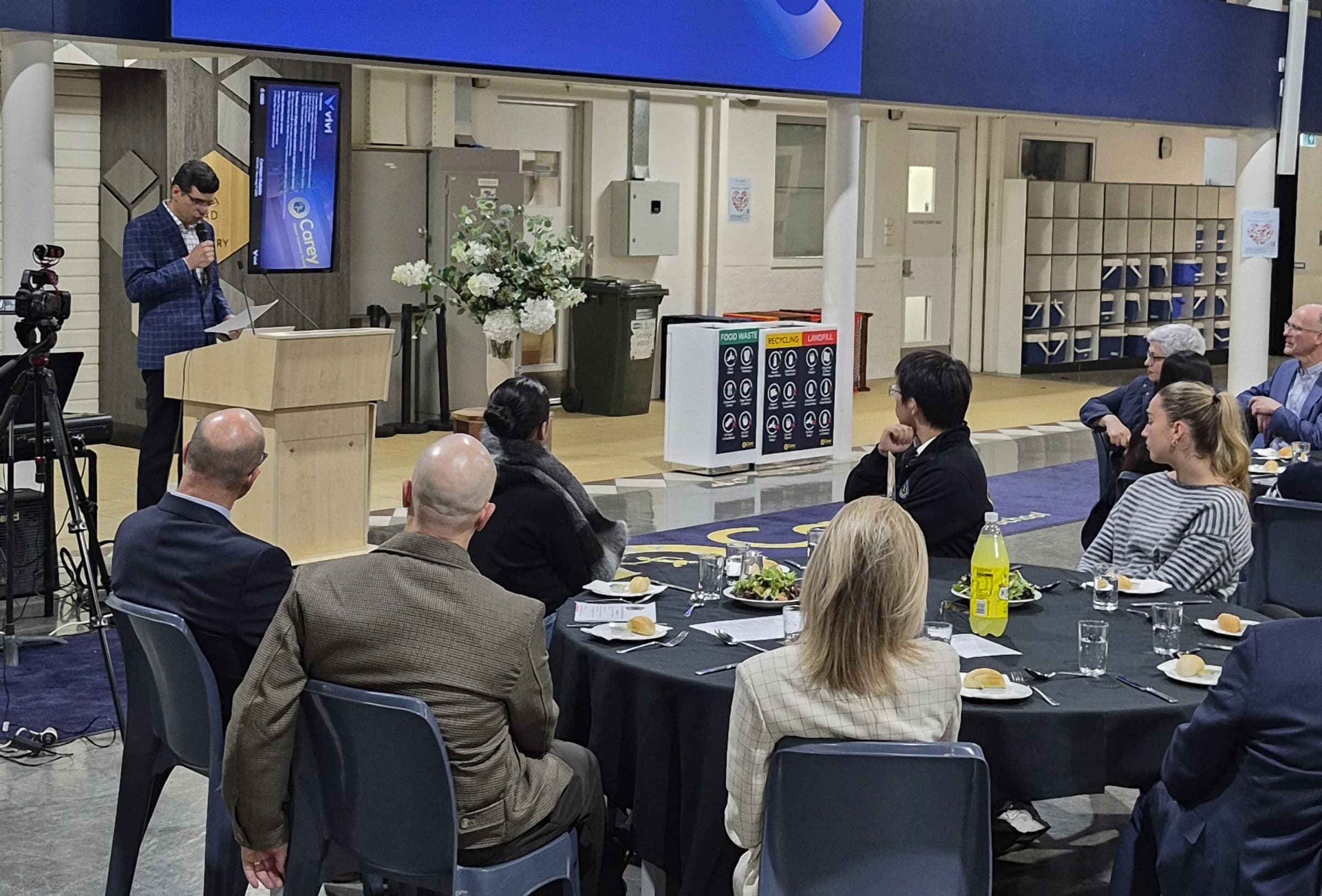
On Monday, Year 12 students attended their second Colloqium Dinner, and were privileged to hear from members of the Carey community about their experiences migrating to Australia.
In addition to hearing from Babak Maboudi, Carey’s Print and Copy Co-ordinator, as well as one of our own Year 12 students who became an Australian citizen this year, Carey invited Moosay and Sarah from the Class of 2018 to share their incredible stories, which were already intertwined before they were born. Both students are from families of refugees from Myanmar, and they became best friends when they met in Australia as children. They both attended Carey from Year 10 to 12 thanks to a Humanitarian Scholarship (now known as the Access and Equity Scholarship). You can read more about Moosay and Sarah on page 34 of Torch Summer 2024.
Babak’s story is equally as moving, and reminds us of the sacrifices many members of our community have made to ensure a better life for their children. With Babak’s permission, we are pleased to share his address to Year 12 students on Monday night:
Last year, all my classmates gathered to celebrate 25 years since our graduation. Due to the current situation in Iran, I could not join them, but they asked me to share a memory from our time at university. My response was:
‘Although I truly miss those days and spending time with friends, I cannot forget how dark those times were. How the rules limited our social freedoms and our ability to make the most of those years.’
You can't believe it, but as students we couldn't freely speak up or express our views about social matters – let alone politics.
My name is Babak Maboudi, and I was born in Tehran, Iran, on the 2nd of September 1977.
All my childhood and university years passed during the Iran-Iraq War and the period that followed it. Although the war ended in 1988, its consequences lasted for more than a decade. The war provided a great excuse for the government to severely limit people's freedoms, and I remember very radical and strict rules being in place throughout my primary school, high school and university years.
I was the first child in a middle-class family, and I have two brothers. I completed my primary and high school education in a suburb called Tehran Pars, east of Tehran. In 1994, I was accepted into the university entrance exam and moved to a city called Urumiyeh, in the far west of Iran, in a province called West Azerbaijan. In 1999, I received my bachelor's degree in applied physics and graduated from university.
After finishing university, I realised that the only way I could work in my field of study was to get a job in the government sector. Considering my experiences during university and my dealings with that system, which I had many problems with, I decided to change my career and start a business in the printing and publishing industry.
It was tough. I started with nothing. Just a PC and a desktop scanner. I began working with industrial companies, designing their packaging and business forms. I prepared artwork for them and had agreements with a couple of printing factories to print the products for me. Later, I started working with several universities and began publishing books for them. Over 12 years of hard work, my business gradually grew, and by the time I decided to leave Iran, I owned a small printing factory and a publishing office, both of which I eventually sold.
In 2009, after the corrupt presidential election in Iran and everything that happened during that year, along with the frustration and hopelessness many Iranians felt afterward, I decided to leave the country. The goal was to move to any place that is not Iran!
So, I started learning English, attending evening classes after finishing work each day. I applied as a skilled migrant to Canada, New Zealand and Australia. On the 12th of December 2012, I was granted a skilled migration visa through the Northern Territory Government.
My son, Farsan, was only nine months old when we moved to Darwin on the 6th of March 2013.
I still remember sitting on the plane just minutes before landing in Darwin. I was holding our baby, my wife resting on my shoulder, and a single thought kept repeating in my mind:
"What will we do?"
We were starting over in a new country without family, friends or any familiarity with the culture.


Although I had achieved a very good score in the IELTS exam, when we arrived in the NT I began wondering whether Australian English was a completely different language.
During the airport inspection, the officer realised I was struggling to understand him and kindly told me to let him know if I needed him to speak more slowly or repeat anything. The problem was that I could barely understand a single word!
I was very lucky that after only one week in Darwin, I found a job in a printing factory. We rented a place in Larrakeyah. Farideh began learning English while taking care of our son. Later, I secured a better-paying job at another printing factory, and we moved to Parap, where our daughter was born in 2016.
In September 2016, I accepted a new job and moved to Melbourne, Victoria. In 2017, I joined the beautiful Carey community.
The main reason my family and I chose to immigrate to Australia was to provide better opportunities for our children. Where I grew up, life could be quite challenging and opportunities for children were limited. Our days were simple: we went to school, came home and played outside. There was not much else available.
The difference between the education and life experiences I see here and those of my own childhood is remarkable. The opportunities, joy, support and encouragement available to students here are extraordinary. When I compare my childhood with the lives my children can live in Australia, I feel grateful beyond words for the opportunities they now have.
To conclude my story, I would like to share three things with you something I often tell my own children.
One: The first generation who choose to leave their country and start over in a new one make sacrifices that many people can hardly imagine. They leave behind family, friends, familiarity, and often their careers, and face countless hardships to create a better future for their children.
That is why the opportunities enjoyed by the children and grandchildren of migrants should never be taken for granted. They are built on years of hard work, courage, determination and sacrifice.
The greatest way to honour those sacrifices is to make the most of the opportunities that have been created for us. Every achievement, every goal reached and every positive contribution is a way of saying ‘thank you’ to those who gave up so much for our future.
Two: Life is not always easy. It is like a road full of holes, and I myself have fallen into almost all of them! My generation in Iran experienced revolution, war and emigration. Any one of those experiences can change a person's life forever, and somehow, I lived through all three.
Life is not designed to be easy. I think difficulty is the default setting. What makes things possible is hard work, persistence and belief in yourself. Whenever life becomes difficult, do not stop trying.
And three: The power is inside you. True strength comes from within, and that strength has a name: hope. Never, ever give up.
The universe does not value how much pain or difficulty you endure, but people will always value how you overcome it and what you create from it.