12 November 2026
Canberra: connecting place, democracy and active citizenship
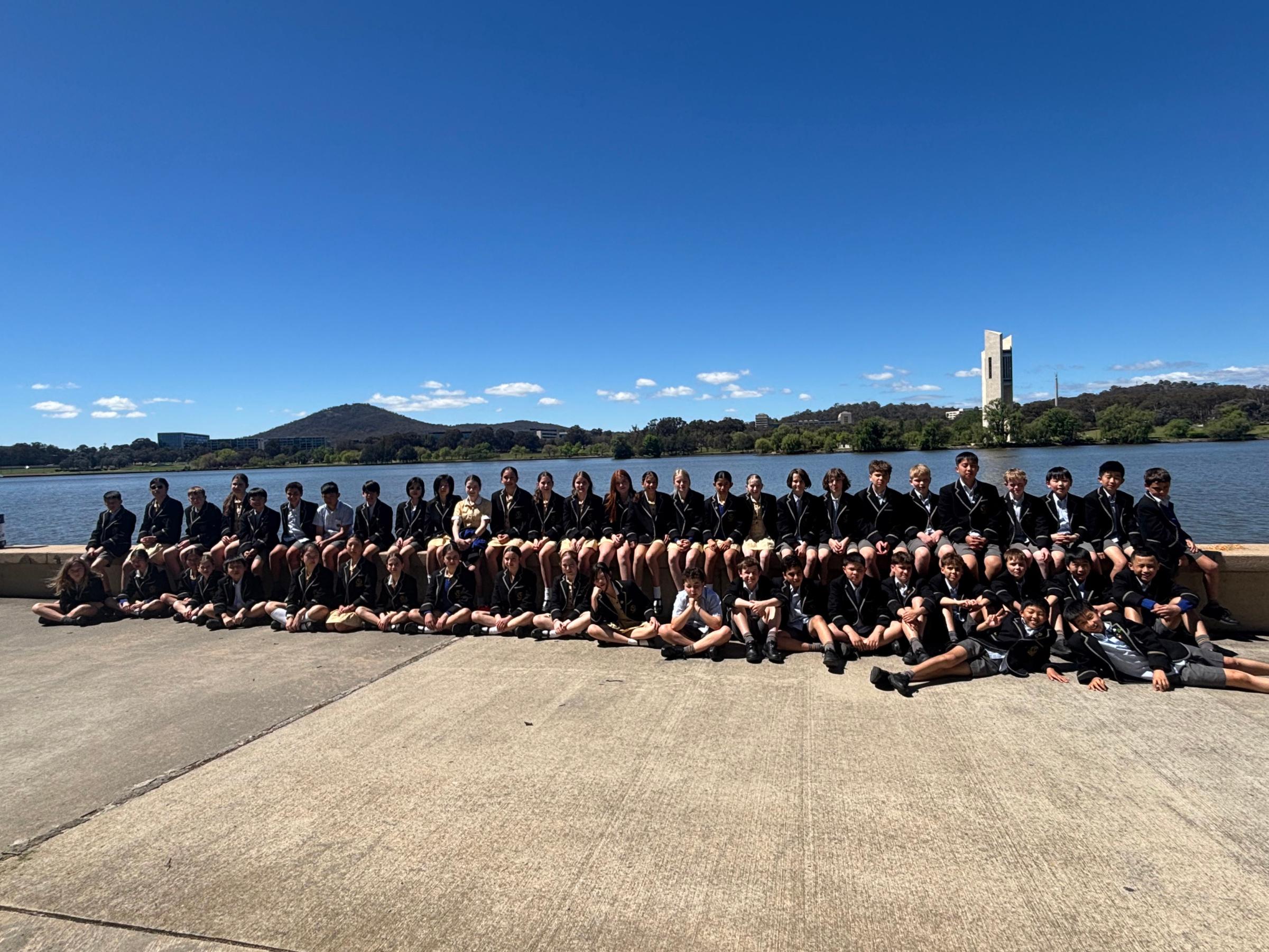
Our Year 6 Kew campus students recently travelled to Canberra as part of their Unit of Inquiry into democracy, government and citizenship. The tour was designed as a ‘finding out’ experience, giving students opportunities to encounter different perspectives and build their understanding as they work towards answering three essential questions:
- What are the features and values of Australia’s democracy?
- What are the roles and responsibilities of government?
- What are our democratic roles and responsibilities as global citizens in Australia?
The learning journey begins with Canberra as a place, its landscape, stories and significance. Students then explore how Canberra became Australia’s national capital and the role its institutions and significant places play in representing and safeguarding Australia’s democratic values.
Visits to the Museum of Australian Democracy at Old Parliament House, the current Parliament House, Government House, the National Electoral Education Centre, the Australian War Memorial and the National Gallery of Australia provide opportunities to consider how Australia’s democratic institutions operate, whose voices are heard and the roles and responsibilities associated with participating in a democracy.
The students’ reflections provide insight into the ideas that captured their attention. Leila’s observations about the Aboriginal Tent Embassy led her to consider fairness, advocacy and the determination of First Nations Australians to bring about change. At the National Gallery of Australia, Bella was interested in the Aboriginal Memorial, particularly the hollow log coffins and their connection to cultural practices. Sophie enjoyed discovering the stories and details within artworks, while Polo reflected on what he learnt about Australia’s wartime history at the Australian War Memorial.
The tour also provided opportunities for students to connect new learning with experiences they have had throughout Junior School. At the Australian National Botanic Gardens, students learnt about the ways native plants have been used by First Nations peoples as tools, food and medicine. Daniel connected this learning with his Kitchen Garden experience, recalling that wattle seed had also been an ingredient used in their cooking.
On the final day, many students cycled around Lake Burley Griffin. Lachlan observed that completing the ride at the end of the tour helped ‘tie the tour together’. Students could see how the landmarks they had visited throughout the week were connected to one another.
One of the provocations students encountered during the tour was, ‘Don’t wait for certainty to act’. This connects directly with the Year 6 focus on the Complex Competency of Active Citizenship, defined as contributing to community wellbeing through empathy, responsibility, dialogue and ethical action. Throughout the year, students developed their capacity to listen to and consider different perspectives, engage in respectful dialogue, take responsibility for their choices and consider how their actions can contribute to the wellbeing of others. The tour provides a context for students to see these ideas reflected in Australia’s democratic institutions, histories and civic life.
The Australian Government recognises the importance of all young Australians being able to visit the national capital as part of their Civics and Citizenship education. To assist families in meeting the cost of the excursion the Australian Government is contributing funding of $45 per student under the Parliament and Civics Education Rebate program towards those costs. The rebate is paid directly to the School upon completion of the excursion.
Emma Chiera
Deputy Head of Junior School – Personalised Learning